What AEO and GEO actually mean
AEO stands for answer engine optimisation. GEO stands for generative engine optimisation. People use both terms for work intended to improve how a business appears in AI answers. The terms overlap; the useful question is which buyer questions you want to appear for.
SEO remains part of that work. Your service pages still need to be findable, understandable and worth visiting. For a visual introduction, see our guide to SEO and AEO.
An answer can involve several searches
Think about this question: “Who can manage Shopee and TikTok Shop for a beauty brand entering Singapore?” It contains a service, two platforms, a product category and a market.
Google says its AI search features may run several related searches while preparing an answer. A single buyer question can therefore lead to multiple supporting pages. The sources and answers can differ between AI Mode and AI Overviews. Google explains the process here.
This is a useful way to plan your content. Write a page that addresses the actual buying decision, including who the service suits and what the work includes.
Give buyers something they can verify
Picture a service page with a large team photo and the words “We deliver results”. The visitor still has to open another tab to find out what the company does.
A more useful page names the service, the customers it fits and the places it operates. It explains the work in enough detail for a buyer to compare options. A relevant example then shows what the team has actually done.
Our view: a clear service page deserves attention before a batch of generic blog posts. An accountant could explain how marketplace payouts are reconciled. A renovation firm could show the decisions behind a completed kitchen. An ecommerce operator could describe who handles listings, advertising and customer messages.
Those are editorial choices you can make today. They are not a published formula for every model’s recommendations.
What we observed with Atsell
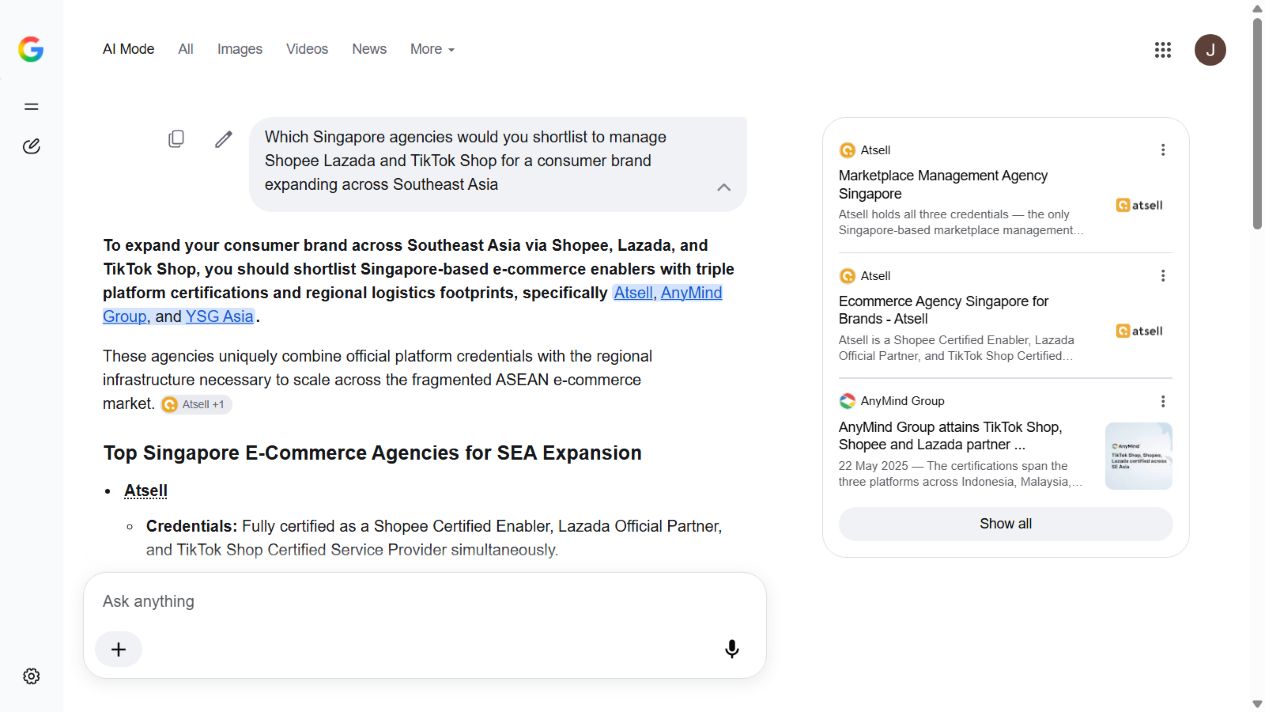
On 13 October 2026, we asked ChatGPT and Perplexity which Singapore agencies they would shortlist for Shopee, Lazada and TikTok Shop management across Southeast Asia. We asked Google AI Mode the same buying question. None of the prompts named Atsell.
All three responses included Atsell. We saved the answers and their sources in our evidence gallery. ChatGPT and Perplexity were signed out; Google used an existing signed-in session. These were individual observations, not a measured recommendation rate.
We also tested an unbranded AEO-agency question on Perplexity. District10 did not appear. The distinction matters: evidence for Atsell’s ecommerce visibility should not be presented as evidence for District10’s own discovery.
Start with one buying question
Choose a question a prospect asked before becoming a customer. Find the page on your website that answers it. If the answer is spread across a PDF, a sales deck and someone’s memory, bring the useful parts onto that page.
Then test the question under consistent conditions and record the result. Start with a page you would willingly send to a prospect.